What is a PRV?

PRV stands for “Pressure Reducing Valve”

It’s a device that is used at your home to reduce the pressure coming from the water system into your house.

Typically, a PRV is installed inside the home right at the point where the water enters the house from the yard or street. A typical PRV for home use looks similar to this:
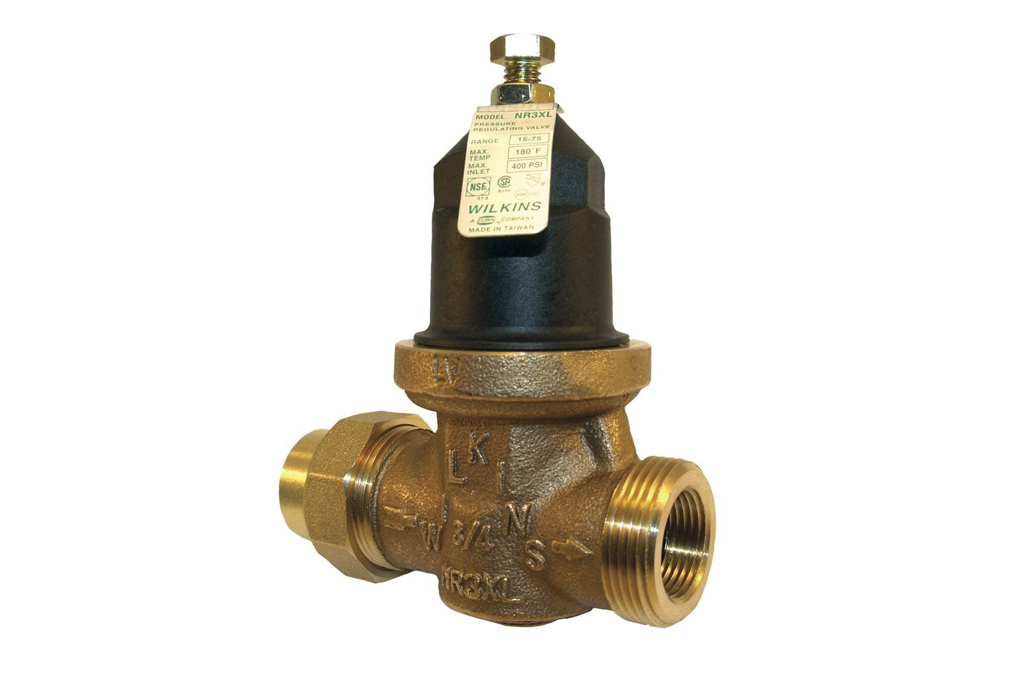
A PRV works by using a spring and a plate to regulate the speed of the water that flows through the valve – as water speeds up, pressure levels drop. By making the opening through the valve smaller, the PRV reduces the pressure on the other side of the valve. PRVs usually come set from the factory at 50 pounds or so, but are adjustable to different levels, typically by turning the bolt at the top of the valve (the section with the yellow tag in the picture). For most PRVs, when the bolt is tightened, pressure inside the house is increased, and when it is loosened pressure is decreased. Typically, it takes very little turning to change the pressure dramatically, so a homeowner attempting to increase or decrease pressure in their house should probably limit turns to 1/4 turn or less and recheck the results before proceeding.

PRVs can also become clogged with debris. Usually to fix this situation the top of the valve must be removed to clean out the PRV. That means water must be shut off first before taking the valve apart. Often, by the time a valve needs to be disassembled for cleaning, the valve has worn to the point where it will not hold pressure properly anyway (the spring inside the valve begins to have fatigue and not expand properly), and it may be prudent to replace the valve at that time. Homeowners uncomfortable with working on basic plumbing within their homes should contact a licensed plumber to do repairs or adjustments, as poor installations or adjustments could cause serious damage to your home. It is the homeowner’s responsibility to determine his or her level of expertise when it comes to installing or adjusting any plumbing devices within their home.
How to Read your Bill

The District mails bills to its residential customers every other month, and to commercial customers monthly.

All regular bills are printed on paper and appears as follows:

1. Account Information

  • Account: This is your unique account number. The format will be six numbers, a dash, and three numbers. For example, your account number might read 012345-000.
  • Service Address: This is the location that you receive service from the District. This might be different than your mailing address.
  • Service Period: This is the time period the bill covers, from the date of the previous meter read to the current read. The District tries to have the reading period approximate 30 days for commercial customers and 60 days for residential customers, but it may fluctuate by 3-5 days for commercial customers and 7-10 days for residential customers.
  • Billing Date: This is the date your bill was generated. Bills are usually generated and mailed on the same day.
    Due Date: This is the date that the current bill is due. Past due balances do not get an extension with the current bill.

2. Meter Reading

  • ID Numbers: These are serial numbers that are unique to your meter and service location. These numbers are for office use.
  • Prior Reading/Current Reading/Usage: These are the readings used to calculate your bill and the total gallons used. Readings are typically in 100 cubic foot increments, so a difference of one between the current reading and the prior reading would be 748 total gallons (there is 7.48 gallons in one cubic foot). In the example above, the change from 2152 to 2158 on the meter was 6 (100 cubic foot increments), or 600 cubic feet. 600 cubic feet X 7.48 gallons = 4,488 gallons, in the example above.

3. Current Charges

  • Water: The amount due for water used. Water charges are calculated by dividing your total usage by 1,000, subtracting 3,000 from that figure (1,500 for monthly customers), and multiplying the remaining number by the current per-thousand rate and adding the minimum monthly charge. For example, if the total usage was 5,000 gallons, the water charges for a Zone 1 customer would be: 5,000 – 3,000 = 2,000/1,000 =  (2 x $3.60, current per-thousand rate for Zone 1) + ($36, current mininum bimonthly for Zone 1) = $7.20+$36 = $43.20 total water charges.
  • Sewer: A fixed charge for sewer services. The rate is set by Metropolitan Sewerage District of Buncombe County (MSDBC), $19.05 bimonthly for a 5/8 meter as of 7/1/2023.
  • Rcycl: Charges for recycling, if applicable. The rate is set by the Town of Weaverville, $7.58 bimonthly for customers inside Weaverville town limits.
  • Penalty: Penalty charges for late payment on your current bill. Penalties are 10% of the current water bill past due.
  • Deposit: Charges due as a deposit, if applicable.
  • Misc: Miscellaneous current charges such as additional meter readings or new service fees.
  • Dep Swr: Dependent Sewer charges. These are your sewer charges based on the amount of water that was used. This can be calculated by dividing total usage by 1,000 and multiplying that number by the current rate, $7.03 per thousand gallons as of 7/1/2023. These charges are in addition to the fixed “Sewer” charges on your bill. Fixed and dependent sewer charges are determined by the Metropolitan Sewerage District of Buncombe County. You can call (828) 255-0061 to learn more about sewer fees and charges or you can visit their website at www.msdbc.org.

4. Bill Summary

  • Previous Balance: This is the total of all previous balances listed on your account prior to the printing of this bill. Generally this is the previous billing period plus any late or disconnect fees.
  • “Prompt Payment”: This is any payments that were made on your account during the previous billing period.
  • Current Charges: These are the current charges, as explained above.
  • Total Amount Due: This the total amount of all past due and current charges that are due on your account. Past due balances are not extended by the current bill. This field demonstrates the total amount that  is outstanding on your bill at the time of the bill’s printing. Past due balances are still due and payable immediately unless arrangements have been made with our office.

How to Read your Meter

Before you can read your water meter, you must locate the meter.

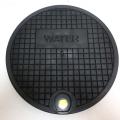
Most meters are located at the edge of your property line near the street. In some areas that are far from a water main, your meter may be located some distance from your house, and in those cases the District can help you identify where your water meter is located. Once you have located the meter box, you can see the meter by removing the meter lid. Most lids are a round two-piece design, where only the inside of the meter lid needs to be raised to look at the meter. This can be done by inserting a screwdriver or other shaft object into the hole in the meter lid to lift it upward. Meter lids look similar to this:

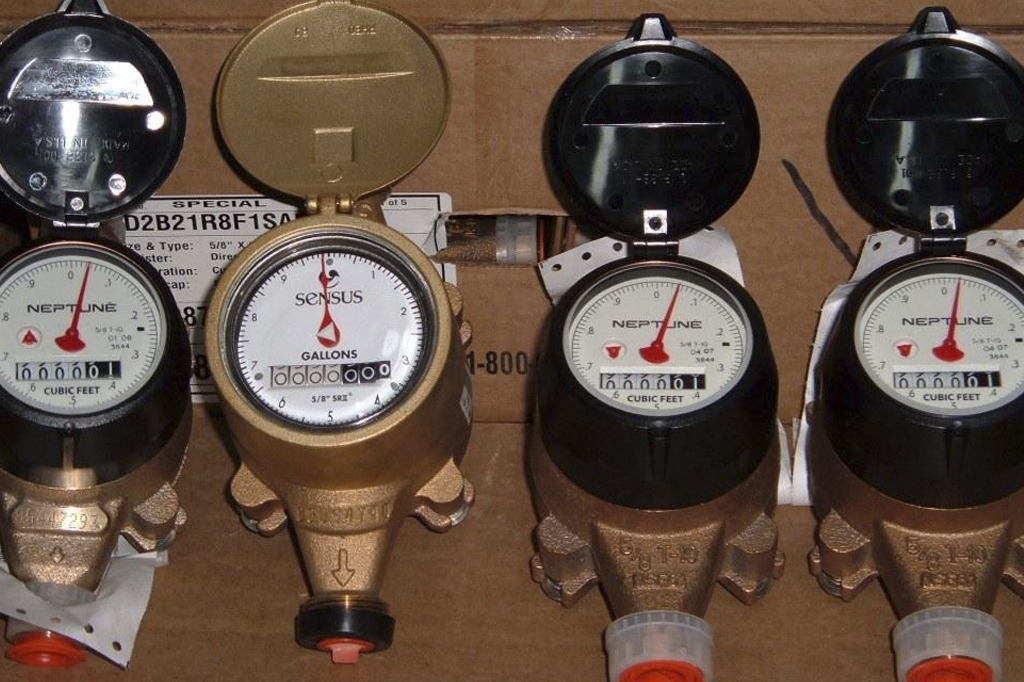
After you have removed the meter lid, you will see a meter that will look like one of the following:

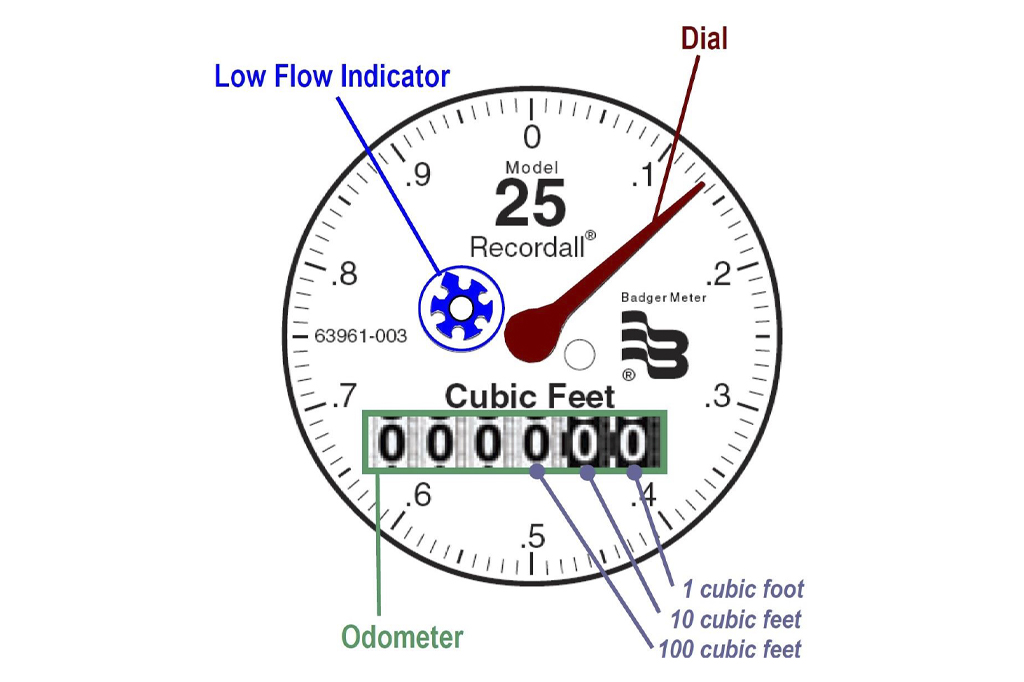
Your meter is read by reading the white odometer dials on the meter face. The last two numbers on the meter are not read when the District reads your meter, but can be used by you in determining your water usage.

Most meters read in cubic feet, and it will tell you the measurement type on the meter face (cubic feet or gallons), so one sweep of the dial all the way around the meter face equals 1 cubic foot of water, or 7.48 gallons of water. The small red triangle on the meter face, or the white/red triangle or pronged wheel at the center of the red sweep handle is a leak indicator – if any water is moving through the meter, the triangle will be turning. If everything in your house is off, and that triangle is moving, you either have a leak somewhere that you can’t see (possibly underground between your house and the meter), or you have something inside your house leaking water slow enough that you may not notice – from a toilet, for example.

You can get a regular idea of your water usage by writing down your meter reading (including the black dials) on one day, and then writing down the numbers at another time – say, the next day – and subtracting the smaller number from the bigger number. That will give you the total cubic feet that has gone through your meter, and if you multiply that number by 7.48 you will get the total gallons you used between readings.

For example, the picture above reads 0000 in the white dials and 01 in the black dials. If you wrote this reading down, and checked it the next day, and the meter read 0000 in the white dials and 26 in the black dials, that would mean you used 25 cubic feet during that day, or 187 gallons of water (25 x 7.48). Using this method, you can compare the water consumption in your house for various water devices – washing machines, taking a shower, watering the lawn, etc – and get a fairly accurate picture of how much water each function uses.

Water Rebate Programs

Save Water & Save Money: Explore Woodfin’s Rebate Programs

The Woodfin Sanitary Water and Sewer District is committed to helping residents and businesses conserve water—and reduce monthly costs along the way. Through two rebate programs, customers can earn account credits or partial refunds when upgrading to efficient devices or maintaining strong payment histories.

Water-Device Rebate Program

If you’re replacing older, less efficient fixtures, you may qualify for a rebate. The program supports upgrades that use less water and meet EPA WaterSense standards. To participate, the upgraded device must replace an older, higher-use model. Applications should be submitted within 60 days of purchase, and an inspection may be required before rebates are issued. Approved rebates appear as account credits unless annual program funds have been exhausted. Note: New construction and renters are not eligible; landlords may apply if their account is in good standing. Visit our Rebates & Incentives page to see if your devices are eligible for this program!

Service Charge Rebate Program

This program rewards Tier II and Tier III customers who maintain a strong payment history. Qualifying renters, tenants, former homeowners, or current homeowners may receive up to 50% of their original service charge back. Once service is discontinued (for tenants/former owners) or eligibility is met (for homeowners), customers may submit the online rebate application. Approved refunds are mailed directly to the address provided. Visit our Rebates & Incentives page to see qualifications for this program!

If you’re upgrading fixtures or maintaining a great payment record, these programs are a simple way to save. Be sure to review full eligibility details and submit your application to take advantage of the benefits available through the District.

Water, From the Sky to Your Faucet

Water is our most precious resource.

While humans can live many weeks without food, we cannot last more than a few days without fresh water. In the United States and most of the Western world, we take the availability of water at the faucet, any time day or night, for granted. The process for getting the water there, however, is more involved than you may think.

Our water story starts at the head waters of Reems Creek, located in the Beech community of Buncombe County. Here, the District owns the entire Sugar Camp Fork and Laurel Fork watersheds (to learn more about watersheds, click here). This land adjoins the Pisgah National Forest, Blue Ridge Parkway, and Asheville watershed. Precipitation over the mountains falls into this watershed and is carried by creeks to a 5 acre manmade reservoir built by the District in 1962. The reservoir is nearly 60 feet at its deepest point, and is held in place by an earthen dam.

From here, water flows by gravity into the District’s treatment plant, which was constructed in 1995. Water enters the treatment plant and is treated with chlorine prior to entering the first stage of filtration, called flocculation. The purpose of flocculation is to get small, invisible or semi-invisible particles to stick together so that they can be filtered out of the water easier.

The next stage of filtration allows the water to flow through a combined charcoal-sand-gravel bed to remove any remaining particles as well as microscopic organisms. This water is then lightly treated with chlorine to maintain its cleanliness and pumped to a storage tank called a clear well, where the chlorine is allowed to contact the water long enough to ensure all bacteria has been eliminated.

From here, water flows through over ten miles of pipe before it gets to the District’s distribution system, where a series of pipes deliver this treated water through a water meter and into your home. In addition to providing the treated water, during this time the District also continually tests the water for safety, provides sufficient water pressure and flow to fire hydrants for fire fighting capabilities, checks meters for consumption, provides billing services, repairs leaks in water lines, and conducts many other operations to ensure that clean, safe water is always available at your faucet, any time day or night.

Backflow Prevention

What is a Cross-Connection?

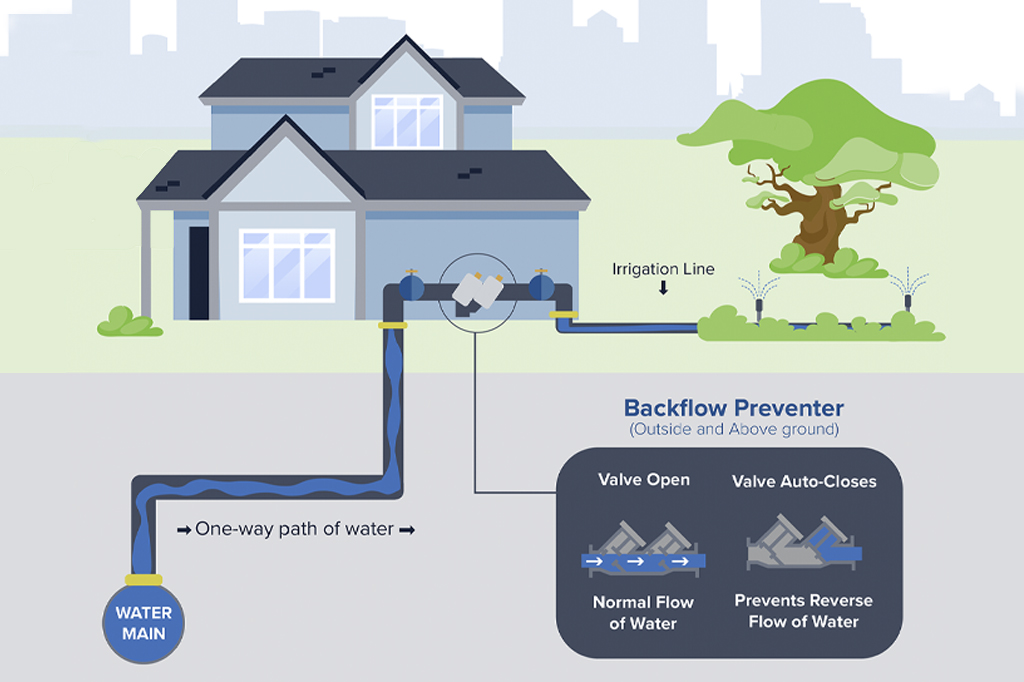
A cross-connection is any actual or potential connection between our public water supply and a source of contamination or pollution. All homes and businesses, due to their connection to our water system, are potential cross connections. The water pipes and fixtures contained within your home or businesses may act as a conduit for contaminated or polluted water during conditions known as backflow.

Backflow occurs when the pressure in the distribution system drops to a level that permits water to flow in the opposite direction of normal flows, pulling water from the customer’s plumbing pipes and fixtures back into the distribution system. When backflow occurs, any other substance in contact with the customer’s potable water system may also be drawn into the distribution system, creating a potential health hazard for water customers. Conditions that may cause backflow include water main breaks and large amounts of water use for fire-fighting purposes.

Examples of Cross-Connections

  • A garden hose with a fertilizer or chemical feeder connected to it that mixes the product with water as it is sprayed.
  • A garden hose outlet submerged underwater, such as a hose lying in a pool or in a bucket of sudsy car-washing solution.
  • A fire-suppression sprinkler system installed in a business.
  • Water contained within a boiler or hot-water heating system.
  • A home or business connected to both the distribution system and a well.
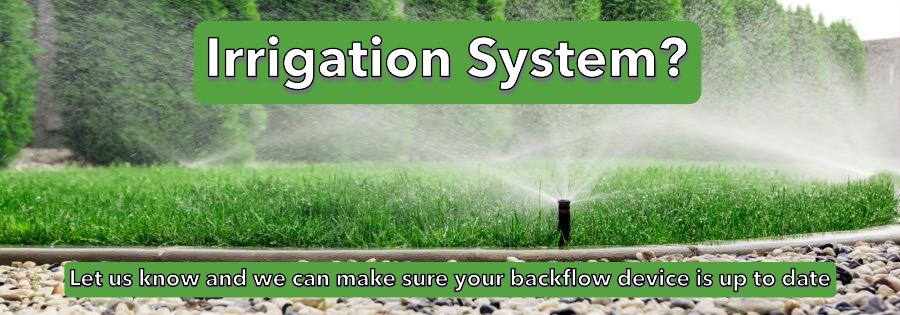
  • An underground lawn sprinkler system
  • A built-in pool or hot tub.
  • A sink faucet or sprayer head submerged in a sink full of water.

What Are My Responsibilities?

The Woodfin Sanitary Water and Sewer District is committed to providing each of its customers the highest quality water possible. In order to meet this commitment, we require customers do their part to minimize the potential of contamination by observing the District’s policies regarding cross-connections:

  • All commercial operations must have proper backflow prevention devices in place as determined by the District
  • New residential customers must have proper backflow prevention devices in place.
  • Existing residential customers should minimize the conditions that can lead to contamination.
  • Ensure that existing backflow prevention devices are operational and are tested by a certified backflow prevention specialist on an annual basis.
  • Recognize that protection from crossconnections is not only District policy but is also the law in the State of North Carolina.

Leak Detection

Leak detection is an important part of water conservation and economics as well. A faucet dripping once a second can leak thousands of gallons per year!

In addition, leaking water costs the District money to treat and distribute, and costs the customer money as a result of larger water bills.

If you suspect that you may have a water leak, the first step is to contact our main office. We can assist you with reviewing your water bill history to determine if usage is unusually high compared to your historical readings. If it does appear high, we will set up an appointment to check your water meter for movement. You will need to be home at this time and make sure that all water-consuming appliances and fixtures are off. One of our technicians will check your meter for movement.

If movement is discovered, and all water devices are off, you’ve got a leak! Here are some tips for checking for leaks on various water devices:

Toilet:

The most common source of leaks in a house is from the toilet. Typically what happens is that the rubber seal inside the tank begins to fail, allowing water to drain from the tank and cause the tank to continuously use water. To check for a toilet leak,

  • Open the storage tank lid of the toilet and pour several drops of food coloring into the tank, enough to strongly color the water of the tank. Put the lid back on and do not use the toilet for 15-30 minutes.
  • Come back and open the toilet bowl lid – if you see colored water in the tank, you have a leak.
  • This type of leak can often be corrected by simply replacing the rubber seal on the tank.

Hot Water Heater:

  • Check around the fittings of your hot water heater for evidence of water.
  • Check the temperature of the hot water heater. Heaters that are set very high may cause the pressure relief valve to open on occasion, draining water from the system.

Sinks & Faucets:

A dripping sink can leak a significant amount of water. This can usually be fixed by replacing the hot and/or cold water stem or washer in the handle. You can determine which side is leaking by turning off the supply to each side (if your sink has separate supply line valves). Repair parts are widely available at do-it-yourself centers and are largely inexpensive.

Outside the Home:

Underground leaks can be the hardest to find. Water can leak from the service line leading from your house to the meter. Water leaks can also be present on underground plumbing lines for swimming pools, fountains, and sprinkler systems.

If you’ve ruled out leaks inside your house, check your yard for soggy spots or areas of standing water. In times of dry weather check for areas with unusually green grass.

Often times leaking service lines are cheapest to simply replace rather than attempting to track down leaks. In many types of soils leaks will rarely, if ever, come to the surface, yet a pinhole leak could result in the loss of thousands of gallons of water per month.

Above all, it is important to remember that most people dramatically underestimate the amount of water used by various activities. A ten minute shower, for example, can consume 50 gallons of water or more depending on your faucet. Car washing and lawn watering may increase your water bill by 50% or more depending on frequency. If you suspect that your water usage may be increasing due to water practices, click here to check our conservation tips.

Water Conservation

Saving water – good for the environment, good for your wallet!

Here in the mountains of Western North Carolina, we have historically been blessed with an abundance of fresh water for commercial, industrial, and residential use. With the enormous growth that the area has witnessed, however, it has become more important than ever to utilize our water supplies in a prudent fashion. Water conservation is not only the responsible thing to do; it can save you significant amounts of money on your water bill! Here are some tips for conserving water around your home or business:

Inside your home:

  • Check for leaks! Click here for tips on finding and repairing water leaks.
  • Turn off water while brushing your teeth, shaving, and washing dishes.
  • Don’t use the toilet for disposing of items.
  • Wash only full loads in your clothes and dishwasher.
  • Take showers instead of baths.
  • Install low-flow fixtures in your bathroom and kitchen.

Outside your home:

  • Don’t leave a hose running when washing your car; better yet, use bucketed water instead.
  • Use a cover to reduce evaporation losses on your swimming pool.
  • Water plants and lawns at night or early morning to reduce evaporation losses.
  • Use mulch to keep soils moist.
  • Consider replacing parts of your lawn with less-thirsty plantings.
  • Aim lawn sprinklers carefully to avoid wasting water on non-lawn surfaces.

At your business:

  • Serve water to restaurant customers only upon request.
  • Use brooms to clean hard surfaces instead of washing them down.
  • Take advantage of xeriscaping to reduce landscape watering needs.
  • Install an instantaneous hot water heater to reduce wasted water waiting on hot water.

Additional Information: